Competitors
Competitors describe Alcoa Corporation's market in their own filings and calls. These verified passages and visual pages show where their strategies meet, using source documents preserved in Sources.
Century Aluminum Company (CENX)
The head-to-head competitor in Alcoa's home market: a US-listed pure-play primary aluminum producer that, like Alcoa, also owns an upstream bauxite-and-alumina position (55% of Jamalco in Jamaica). Century claims to smelt the majority of America's primary aluminum, is the loudest corporate advocate of the Section 232 tariff regime that reprices Alcoa's Canadian metal, and is building — with Emirates Global Aluminium — the first new US smelter in nearly 50 years, a project sized to reset the domestic supply balance Alcoa sells into.
Century's own share claim in the market Alcoa's US smelters sell into — described by management as smelting nearly 60% of American primary aluminum — together with the Oklahoma joint venture with Emirates Global Aluminium. The 750,000-tonne figure and the "more than double total U.S. aluminum production" claim are Century's; the project has not reached final investment decision, which management elsewhere on this call places at the end of 2026.
Jesse Gary, President and CEO — prepared remarks, Q4 2025 earnings call: No company is more dedicated to U.S. aluminum production than Century. Century is already the largest producer of aluminum in the United States, smelting nearly 60% of the country's primary aluminum, employing more American primary aluminum workers than any other company, and thanks to President Trump's leadership and the Section 232 program, we plan to invest billions more in new and expanded production at Mt. Holly and our Oklahoma smelter project. This has all been enabled by President Trump and the administration's policies, including the Section 232 program, which continues to be enforced with no exceptions and no exemptions. […] To this end, Century made substantial progress on our new smelter project in 2025, culminating in our recently announced partnership with EGA to build the first new smelter in the U.S. in nearly 50 years. By combining efforts with EGA, we will pair Century's significant operating and supply chain expertise in the U.S. with EGA's world-class expertise in aluminum smelting technology, construction, and operation. As partners in the Oklahoma smelter, EGA will own 60%, and Century will own 40%, and the project will benefit from our previously announced $500 million grant from the U.S. Department of Energy. The project recently retained Bechtel to complete the next stage of engineering work, which should enable a final investment decision in groundbreaking by the end of the year. […] This has allowed us to increase the expected size of the smelter to 750,000 metric tons, which alone will more than double total U.S. aluminum production and expand Century's position as the largest American producer.
p. 1 · Read in context →
Century's 10-K statement of why its asset locations matter: production inside the two tariff walls, sized against regional deficits it does not quantify. This is the structural fault line with Alcoa, whose Québec smelters ship into the US from outside the tariff wall and whose Australian and Brazilian output sits outside both.
Century Aluminum Company, Form 10-K (FY2025), Item 1 — Competitive Advantages: Duty Free Access to our Major Customer Markets. Our facilities benefit from international and national trade laws and regulations. For example, the European Union imposes import tariffs on primary aluminum from producers outside the European Economic Area (the "EEA"), which includes Iceland, and the U.S. currently imposes a 50% tariff on certain primary aluminum imports into the United States. Our U.S. and Icelandic businesses currently access these respective markets duty-free which provides us with an advantage over our competitors who sell into these markets under these tariff regimes. […] The U.S. and the E.U. are the second and third largest aluminum consuming regions in the world but do not produce enough aluminum domestically to satisfy their own demand. Our production locations within these markets provide us with a significant competitive advantage over our foreign competitors by providing our customers with short, reliable supply chains, better technical service and opportunities for value added collaboration. Our U.S. facilities benefit from the proximity to our U.S. customer base, allowing us to capture the Midwest premium and providing a competitive advantage in freight costs over our foreign competitors.
p. 13 · Read in context →
Century's sizing of the 2026 supply shock — roughly 2.5 million tonnes of Gulf capacity disrupted, widening its own global deficit estimate — and its reading of the April 2 executive order that it says closed Section 232 valuation loopholes in downstream extruded products. Both the disruption tonnage and the deficit are Century estimates presented on its own slides; the deficit figure, completed on the following page, is 1.4 million tonnes.
Jesse Gary, President and Chief Executive Officer — prepared remarks, Q1 2026 earnings call: In the U.S. specifically, we are already beginning to see increased value-added product demand following President Trump's April 2 executive order that closed valuation loopholes that importers have been using to cheat the Section 232 system, especially in downstream extruded products. We are grateful to President Trump for taking this additional action to ensure that the entire U.S. aluminum supply chain is able to grow and expand to meet our domestic national security needs with American metal. […] Turning to the supply side. The importance of ensuring secure U.S. supply chain has never been so evident as today following disruptions in production in the Middle East. We estimate that approximately 2.5 million tons of production in the Gulf countries has been disrupted by either production curtailments due to raw material shortages arising from the closure of the Strait of Hormuz or direct Iranian drone and missile attacks. We stand by our industry colleagues who have been so unfairly affected by such attacks. Note that, while the large majority of Middle Eastern metal goes to the European and Asian markets, Century has been supporting our existing U.S. customers that have been impacted by the Middle East disruption through the placement of our expansion tons from Mt. Holly to repair these strained supply lines and ensure our U.S. customers have access to the metal that they need. The timing of our Mt. Holly restart could not be better in this regard, providing additional American metal units to the domestic market. As you can see on Slide 6, the Middle Eastern disruption has expanded our expected 2026 global deficit
p. 1 · Read in context →
Rio Tinto (Aluminium & Lithium) (RIO)
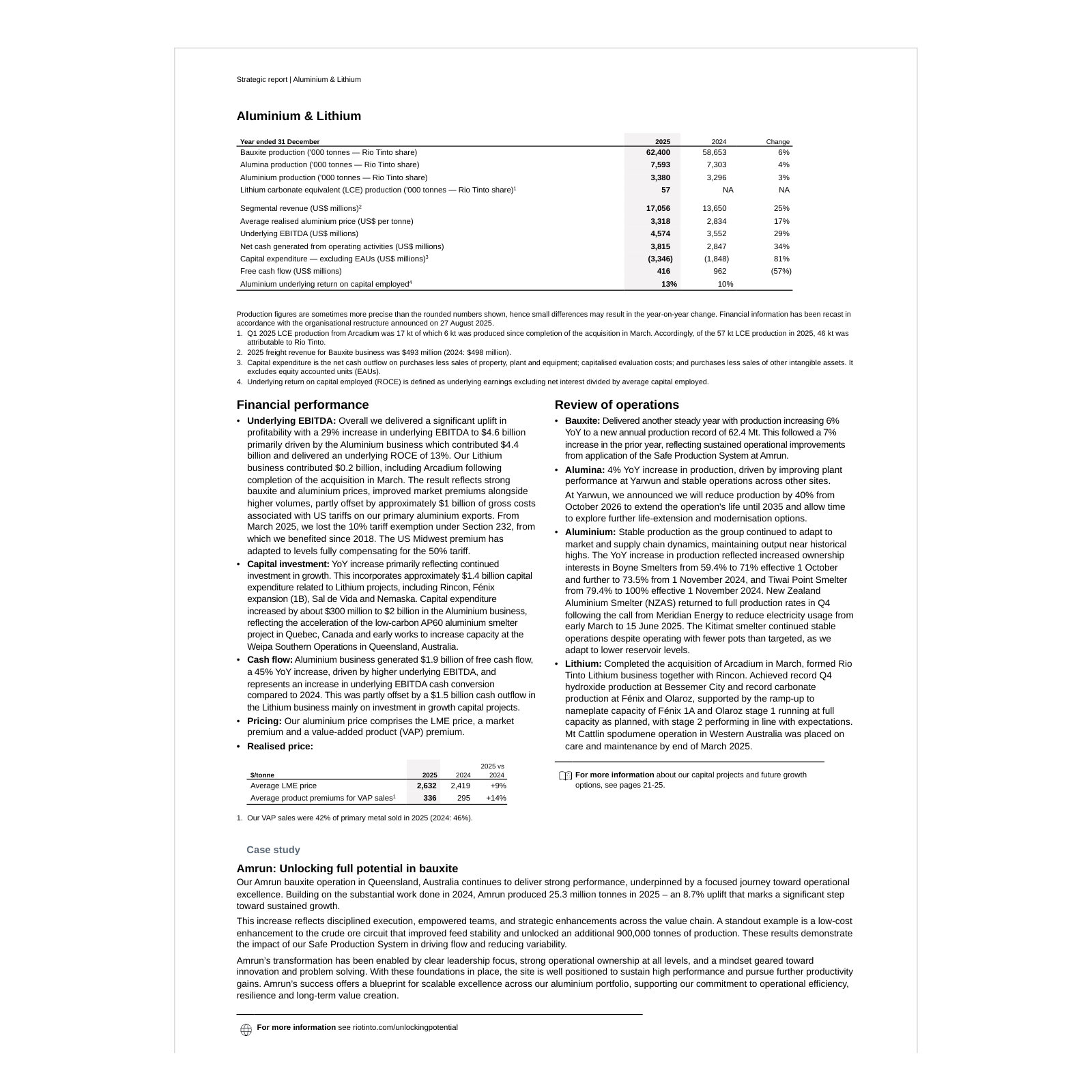
The closest structural mirror to Alcoa anywhere: bauxite mining, alumina refining and hydro-powered smelting under one roof, with Canadian and Australian assets facing the same tariff and energy questions. Rio is simultaneously Alcoa's partner — the ELYSIS inert-anode joint venture and co-ownership of the CBG bauxite mine in Guinea — and its rival for the same US value-added customers. Only the Aluminium & Lithium disclosures are used here; iron ore, copper and lithium are outside the competing business.
Rio Tinto's disclosure of how dependent its aluminium book is on the US: 59% of total volumes priced off the Midwest premium in 2024, versus 57% in 2023. This is the exposure that the 2025 tariffs then repriced, and it is the same premium that flows through Alcoa's US-delivered tonnes.
Rio Tinto, 2024 Annual Report — Aluminium, financial performance: We achieved an average realised aluminium price of $2,834 per tonne, 4% higher than 2023. The average realised aluminium price comprises the LME price, a market premium and a value-added product (VAP) premium. The cash LME price averaged $2,419 per tonne, 8% higher than 2023, while in our key US market, the Midwest premium duty paid, which is 59% of our total volumes (2023: 57%), decreased by 17% to $427 per tonne (2023: $512 per tonne). Our VAP sales represented 46% of the primary metal we sold (2023: 46%) and generated product premiums averaging $295 per tonne of VAP sold (2023: $354 per tonne).
p. 106 · Read in context →
Rio's CEO in February 2025, before the tariff rate was settled, describing the option Alcoa also holds — redirect metal away from the US and let others fill the gap. Note the framing that a uniform tariff is neutral and only a selective one bites. Rio's 2025 accounts settled the question: US$1,059 million of cost from tariffs imposed on sales to the US, against nil in 2024 (2025 Annual Report, note 7).
Jakob Stausholm, Chief Executive Officer — answering Rahul Anand (Morgan Stanley) on US tariffs, FY2024 results call: Bear in mind that we produce a lot in the U.S., different products. And then a number of products are being imported for us into the U.S. So, first of all, the economic impact on tariffs to Rio Tinto might be both pluses and minuses, and we don't know whether the net will be positive or negative. But it really depends on how the tariff hit.
If all countries are getting a tariff, the impact for us is zero. The problem is if it's only one country and the country we are selling into. But then, of course, we could redirect our aluminium to other markets, and other producers will supply the U.S. market.
p. 13 · Read in context →
Norsk Hydro ASA (NHY)
The other fully integrated Western producer: Paragominas bauxite feeding Alunorte — which Hydro calls the biggest alumina refinery in the world outside China — plus 2.1 million tonnes of primary capacity. Hydro's annual report is the most detailed published account of the two prices that drive Alcoa's segments, the alumina index and the regional metal premiums, and it publishes a 2026 balance view that runs directly against Century's.
Hydro's description of the refining asset that anchors the non-Chinese alumina market and its published cost build. The 85%-of-cash-cost split across bauxite, energy and caustic soda is the same cost structure that moves Alcoa's Alumina segment; Hydro's caustic share is disclosed at roughly 16% for 2025.
Norsk Hydro, Integrated Annual Report 2025 — Business areas, Bauxite & Alumina: Hydro Bauxite & Alumina covers Hydro's bauxite mining activities in
Paragominas and the company's 62 percent interest in the Brazilian alumina refinery, Alunorte, both located in Pará State, North of Brazil. Alunorte is the biggest alumina refinery in the world outside China, with nameplate capacity of 6.3 million tonnes per year. […] The main cost drivers for alumina refining are bauxite, energy and caustic
soda. These represent around 85 percent of cash costs, where caustic soda represented around 16 percent of cash costs in 2025. Energy costs are a mix of gas, coal, and electricity, and account for about 30 percent of the total costs.
p. 22 · Read in context →
Hydro's account of the 2025 alumina reversal: the Platts index from USD 672 to USD 306 per tonne, a 24% lower annual average, and an alumina-to-LME ratio ending the year at a record low. That ratio is the single largest swing factor in Alcoa's Alumina segment earnings.
Norsk Hydro, Integrated Annual Report 2025 — Market development and outlook, Bauxite and alumina: Following very tight alumina markets and all time high nominal prices in 2024, the global metallurgical alumina market rebalanced in 2025: production growth of 3.1 percent exceeded demand growth of 1.8 percent, driving prices lower throughout the year. The Platts alumina price index started the year at USD 672 per mt and decreased throughout the year, ending the year at the annual low of USD 306 per mt. […] The Platts alumina price index averaged USD 384 per mt for the year, a 24 percent decrease compared to 2024 (USD 504 per mt). […] The price index at the end of 2025 represented 10.2 percent of the three month aluminium price quoted on LME, a new all time low.
p. 34 · Read in context →
Hydro's premium data for 2025: the US Midwest premium quadrupling from USD 515 to USD 2,007 per tonne on tariffs, while the European premium fell — and Hydro attributes part of that European weakness to Canadian metal displaced into Europe. Alcoa is one of the largest shippers of Canadian metal, so both halves of this sentence are read against its book.
Norsk Hydro, Integrated Annual Report 2025 — Market development and outlook, Primary aluminium: The U.S. and European standard ingot premiums started the year at USD 515 per mt and at USD 360 per mt respectively. European standard ingot premiums were volatile throughout the year reaching a bottom of USD 188 per mt in summer and ending in December at USD 335 per mt. The premium was under pressure during the first half of 2025 due to a flow of Canadian metal coming into the market, but have since regained footing on a tightening market. […] The U.S. Midwest standard ingot premium had a volatile year as well, starting the year at USD 515 per mt and ending the year at USD 2,007 per mt. In general, the U.S. Midwest increased on increased tariff rates on aluminium into the U.S.. Average U.S. Midwest standard ingot premium increased USD 868 per mt compared to 2024, while corresponding standard ingot premiums in Europe decreased about USD 62 per mt.
p. 35 · Read in context →
Aluminum Corporation of China Limited (Chalco) (2600)
The largest producer in both of Alcoa's segments. Chalco competes with Alcoa less for customers than for the price itself: Chinese refineries set the marginal alumina tonne, and Chalco's annual report is the most explicit published sizing of that market. It is also the peer that names Alcoa directly, citing the Kwinana refinery closure as a driver of the 2024 alumina spike.
Chalco's own ranking claim, unqualified and unsourced: first in the world in alumina, fine alumina, electrolytic aluminum, high-purity aluminum and gallium capacity. The descriptive scope — bauxite and coal mining through alumina, primary metal, alloy and carbon — is the same vertical integration Alcoa describes for itself, which is why Chalco's capacity decisions land directly on Alcoa's realised prices rather than on its customer list.
Aluminum Corporation of China Limited, Annual Report 2025 — Corporate Profile: The Company and its subsidiaries (the “Group”) is a leading enterprise in aluminum industry in China, ranking among the top in the global aluminum industry in terms of overall strengths. The Group’s alumina, fine alumina, electrolytic aluminum, high purity aluminum and gallium metal production capacity all rank first in the world, and is a large manufacturer and operator with integration of exploration and mining of bauxite, coal and other resources; production, sales and technology research of alumina, primary aluminum, aluminum alloy and carbon; international trade; logistics business; thermal and new energy power generation.
p. 4 · Read in context →
Chalco's sizing of the market Alcoa's Alumina segment sells into: 150.5 million tonnes of global output against 147.3 million tonnes of consumption in 2025, with China at roughly 62% of supply, and world capacity utilisation at 75.6%. The spare capacity implied here is the structural reason the international price fell 22.7%.
Aluminum Corporation of China Limited, Annual Report 2025 — Chairman's Statement, alumina market: In 2025, the average domestic spot price of alumina was RMB3,221 per tonne, representing a year-on-year decrease of $21.1\%$ . In the international market, the overall trend of alumina prices was basically consistent with that of the domestic market, with a full-year average price of USD388 per tonne, representing a year-on-year decrease of $22.7\%$ . […] According to the statistics, the global output and consumption of alumina for 2025 were 150.49 million tonnes and 147.33 million tonnes, respectively, representing a year-on-year increase of 6.0% and 1.9%, respectively; the domestic output and consumption of alumina were approximately 92.94 million tonnes and 88.67 million tonnes, respectively, representing a year-on-year increase of 8.3% and 1.9%, respectively, accounting for 61.8% and 60.2% of global output and consumption, respectively. As of the end of December 2025, the alumina capacity utilization rate in the world was 75.6%, while that of the PRC was 80.9%.
p. 46 · Read in context →
A competitor's account of the 2024 alumina spike that names Alcoa's own asset: the Kwinana curtailment, at roughly 1.8 million tonnes per year, listed alongside Rio Tinto's Queensland gas-pipeline outage as the supply losses that carried the international price to USD 810 per tonne. Useful as an outside check on how Alcoa's curtailment decision was read by the largest producer in the market.
Aluminum Corporation of China Limited, Annual Report 2024 — Chairman's Statement, international alumina market: In terms of the international market, there were frequent disruptions in the supply side of alumina in 2024. In early March, due to the impact of the Australian natural gas pipeline fire, the operating capacity of Rio Tinto's Yarwun alumina plant and Queensland alumina plant decreased by approximately 1.2 million tonnes per year. The planned resumption was postponed from June to the end of the year. Rio Tinto Group announced force majeure in May regarding the shipment of two alumina plants in Australia. In April, due to the decline in ore grade and high costs of outdated equipment, Alcoa shut down its Kwinana alumina plant in Western Australia, affecting production capacity of approximately 1.8 million tonnes per year. Starting from the second quarter, overseas alumina supply further declined, supporting prices to continue rising and reaching a high point for the year by early December. Afterwards, due to the lifting of the force majeure on alumina exports by Rio Tinto Group and the return of normal operation of alumina plants in Australia, alumina prices quickly fell back after reaching their peak. In 2024, the highest international alumina (FOB) price was USD810/tonne, the lowest was USD354/tonne, and the average price was USD502/tonne, representing a year-on-year increase of 46%.
p. 50 · Read in context →
Vedanta Limited (Aluminium) (VEDL)
India's largest primary aluminium producer and, on its own account, on track to the third-largest capacity outside China. Vedanta matters to an Alcoa reader for two reasons: it is the growth tonnage arriving in the ex-China market Alcoa serves, and it publishes per-tonne cost of production for both alumina and molten metal — a cost-curve yardstick Alcoa does not disclose in that form. Only the Aluminium segment is used; zinc, oil and gas and iron ore are separate businesses.
Vedanta's sizing of the market Alcoa's Aluminum segment sells into: about 73.8 million tonnes of CY2025 global production, roughly matched by demand, plus a claimed 46% share of an Indian market growing near 10%. The first elision drops a sentence putting the CY2025 balance at a deficit of about 0.2 million tonnes — it is elided because our text index of that line is garbled, not because it cuts against the rest. Set this against the 2026 forecasts the peers publish in the same season: Norsk Hydro calls a 0.2 million tonne surplus, Century a 1.4 million tonne deficit.
Vedanta Limited, Integrated Annual Report FY 2025-26 — Segment Review, Aluminium: In CY 2025, global primary aluminium production was \~1.1% up from last year and around 73.8 million tonnes. […] China’s production increased in CY 2025 was 44.2 MTPA. In India, the demand surged by \~10% to around 6 million tonnes in FY 2025-26. […] For the Rest of the World, 2026 is
expected to experience volatile market due to macroeconomic conditions like tariffs from USA, and geopolitical situations impacting trade flow & fuel and commodity prices and decrease in global production capacity due to expected shutdown of South32 Aluminium Smelter (Mozal) from March 2026. […] Vedanta is India’s largest primary aluminium producer with an annual capacity of \~2.4 million tonnes. The Company’s product portfolio includes aluminium ingots, primary foundry alloys, wire rods, billets, and rolled products which cater to varied industries globally such as energy, transportation, construction and packaging, aerospace and defence, among others. It has achieved domestic market share of 46%.
p. 113 · Read in context →
The cost-curve comparison Alcoa's own filings do not present this way: Vedanta reports molten aluminium at US$1,752 per tonne and alumina at US$372 per tonne for the year to March 2026, both falling, against an LME price that closed the period at US$3,585. Vedanta's cost base is coal-fired and captive-bauxite-fed, so it is not like-for-like with Alcoa's hydro-powered Canadian and Norwegian smelters, but it sets the floor a low-cost entrant can operate at.
Vedanta Limited, Integrated Annual Report FY 2025-26 — Aluminium, unit costs and prices: LME prices which had fallen to levels of US$ 2,300/tonne in Apr-25 reached the highs of US$ 3,300/tonne in Jan-26. However, in the absence of fresh market drivers, prices reverted to previous support levels of around US$ 3,000/t. However, in March, heightened geopolitical developments involving the United States, Israel, and Iran led to increased regional tensions and temporary disruptions to smelting operations, resulting in an uptick in prices. The rally in prices has been augmented by operational disruptions at EGA and Alba smelters on 28 March. The year concluded with an LME price of US$ 3,585/t on 31 March, with a month average of US$ 3,370/t. […] Cost of production (CoP) of alumina was at US$ 372 per tonne, up 5% Y-o-Y, majorly due to lower domestic bauxite mix.
CoP of molten aluminium for FY 2025-26 was at US$ 1,752 per tonne, down 5% Y-o-Y, majorly due to reduction in Alumina and Power costs on account of higher captive Alumina mix, softened market alumina prices, & lower coal costs. This was offset to an extent by higher CPC prices & other processing cost.
p. 131 · Read in context →
More peer documents
Q3_FY2025 — 8 pages · Century's capital-allocation framework and the earlier version of the Oklahoma smelter plan, before the EGA partnership was announced — the baseline against which the 40/60 JV structure should be read. · Open →
Q2_FY2025 — 8 pages · The first full quarter after the US tariff moved to 50%; management's contemporaneous read on how fast the Midwest premium repriced, which is the pass-through Alcoa's US-delivered tonnes also received. · Open →
CENX_annual_report_FY2024 — 117 pages · Contains Century's detailed Jamalco property disclosure, including the history of Alcoa's mining concessions and refinery in Clarendon — useful background on the asset Alcoa sold out of in 2014. · Open →
NHY_annual_report_FY2024 — 283 pages · The prior-year edition of the same market chapter, written at the top of the alumina spike; reading the two side by side shows how fast a peer's published view of the alumina market inverted. · Open →