Annual Reports
Alcoa Corporation's annual reports contain management's most considered account of the business. These are the sections, passages and visual pages worth opening in the originals preserved in Sources.
Alcoa Corporation — FY2025 Annual Report (Form 10-K) — FY2025
The latest full account: two segments, asset-by-asset capacity, and the mine-approval and San Ciprián issues management calls decisive. · Open the full document →
Item 1. Business — The Company — p. 3 · Read the full section →
The opening definition of the business: two segments, 25 operating locations, and revenue set by two published indices rather than by Alcoa.
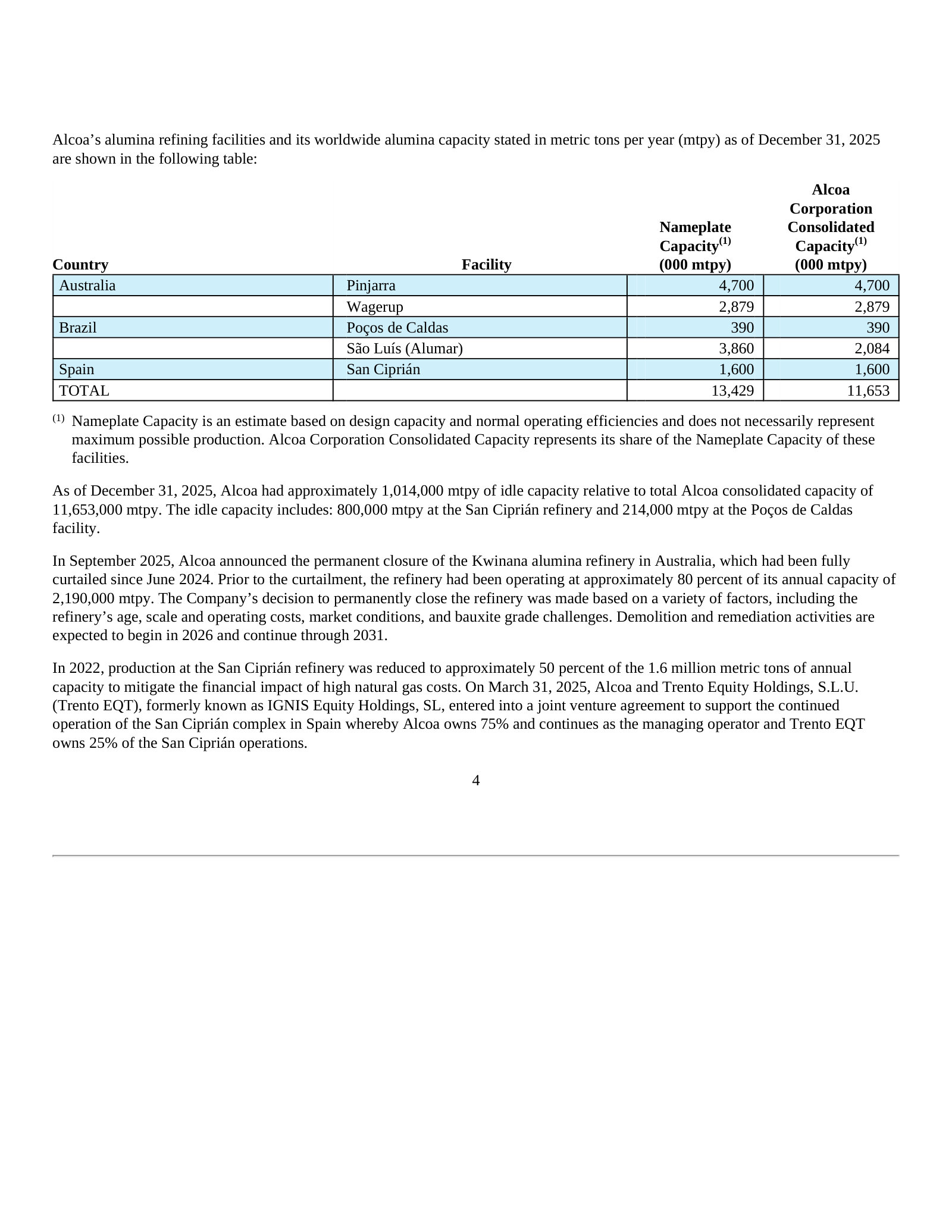
Alumina — p. 6 · Read the full section →
The upstream half of the company, and the clearest statement of how alumina is priced and how much of it is sold to Alcoa's own smelters.
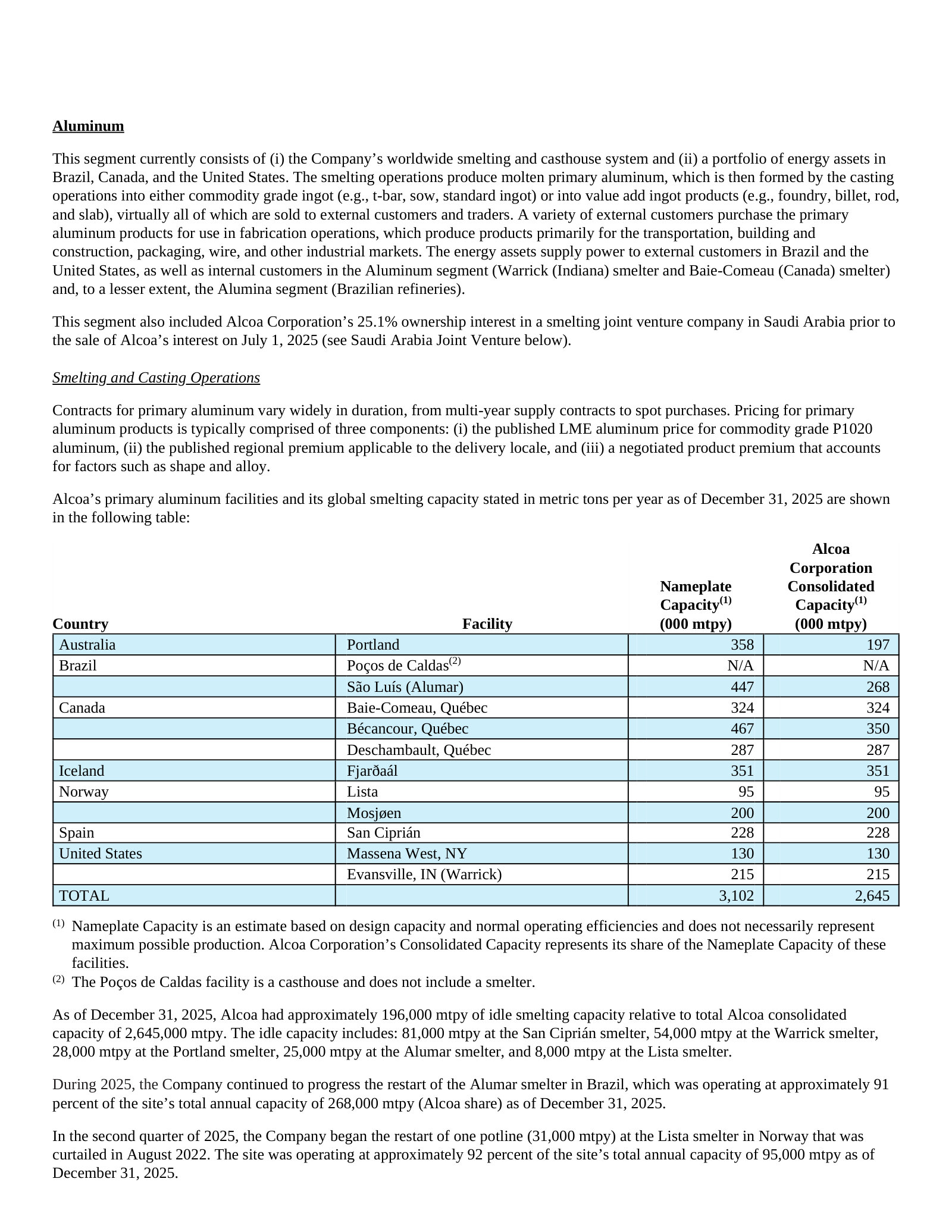
Aluminum — p. 8 · Read the full section →
The downstream half: the three-part price a smelter actually realizes, and the idle capacity that sits behind restart optionality.
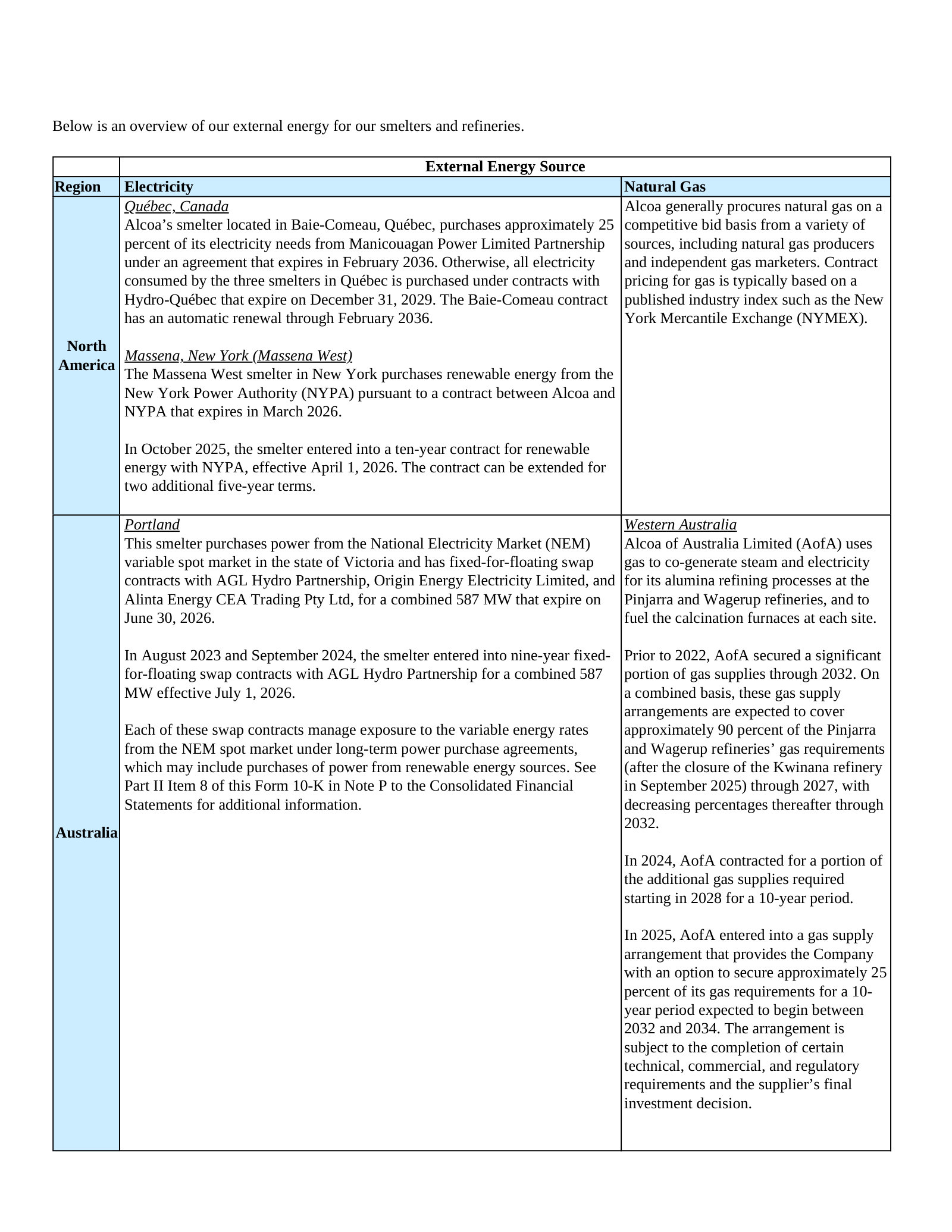
Energy Facilities and Sources — p. 10 · Read the full section →
Energy is roughly a quarter of both refining and smelting cost; this is where the contracts and expiry dates that fix that cost are set out.
Competition — p. 19 · Read the full section →
Alcoa's own placement on the cost curve, including the admission that lower Australian bauxite grades could cost it the first quartile.
We have in the past been and may in the future be unable to obtain, maintain, or renew permits or approvals necessary for our mining operations, which could materially adversely affect our operations and profitability. — p. 30 · Read the full section →
The most company-specific risk on the list: permitting delays have already forced Alcoa into lower-grade bauxite, raising refining costs.
Permitting risk stated as something that has already happened, not just a hypothetical.
Our mining operations are subject to extensive permitting and approval requirements. These include permits and approvals issued by various government agencies and regulatory bodies at the federal, state, and local levels of governments in the countries in which we operate. […] Failure to obtain, maintain, or renew permits or approvals, or permitting or approval delays, restrictions, or conditions has in the past and may in the future impact the quality of the bauxite we are able to mine and could increase our costs and affect our ability to efficiently and economically conduct our operations, potentially having a materially adverse impact on our results of operations and profitability.
p. 30 · Read in context →
Our operations and profitability have in the past and could in the future be impacted by rising energy costs and interruptions or uncertainty in energy supplies. — p. 32 · Read the full section →
The second risk that has already bitten: San Ciprián's losses and the Iberian power outage that paused the smelter restart.
San Ciprián as the worked example of energy-cost exposure; restart at ~65% of capacity, completion expected mid-2026.
Our refineries and smelters consume substantial amounts of natural gas and electricity in the production of alumina and aluminum. The prices for and availability of energy have in the past and could in the future be impacted by volatile market conditions resulting from factors beyond our control such as weather, political, regulatory, and economic conditions. For example, the San Ciprián refinery and smelter incurred substantial losses in 2025 and in prior years as a result of a challenging economic environment, primarily due to the high cost of energy. […] The restart of the San Ciprián smelter was paused in April 2025 following a widespread power outage across Spain and resumed in July 2025. The smelter was operating at approximately 65 percent of its total annual capacity of 228,000 metric tons as of December 31, 2025 and the Company expects that the restart will be completed by mid-2026.
p. 32 · Read in context →
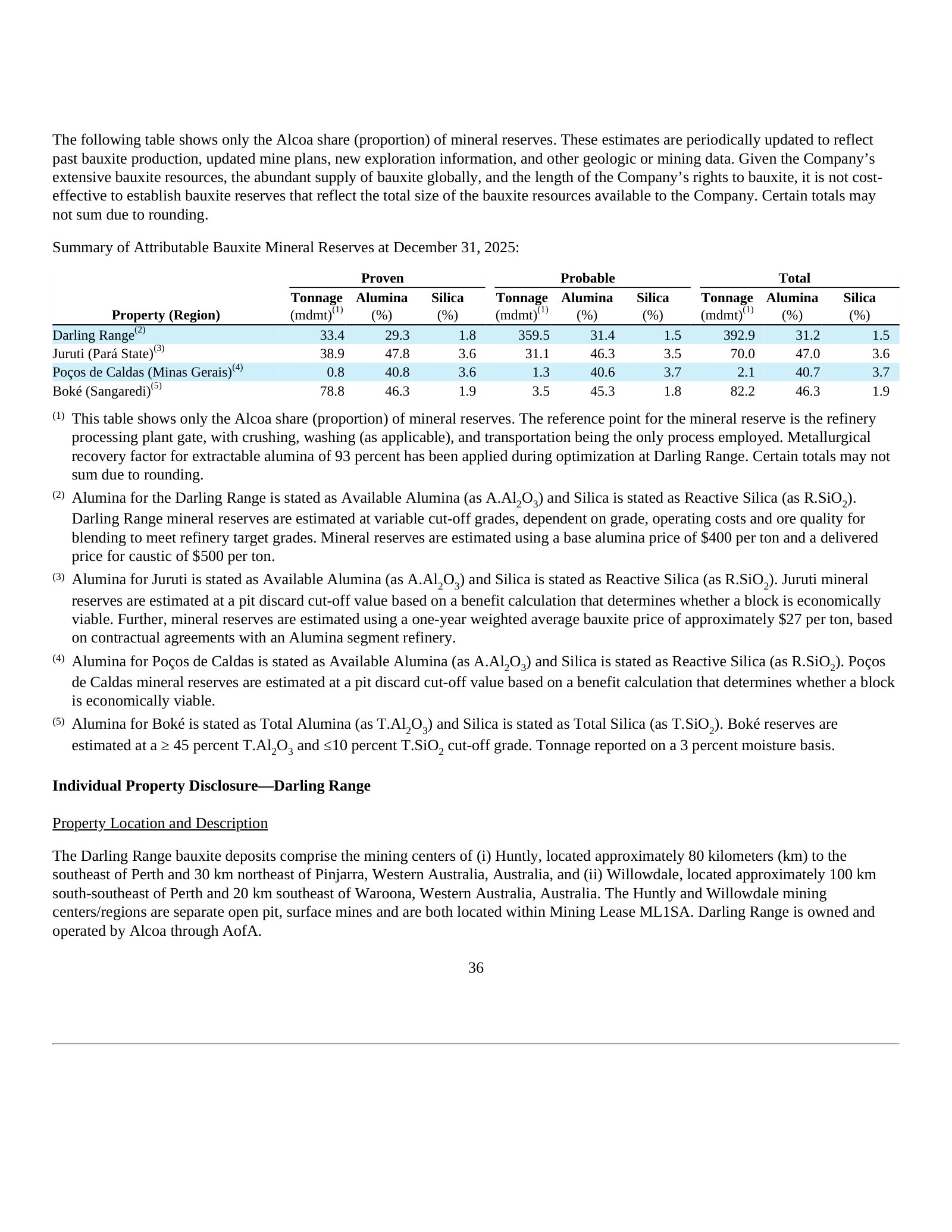
Bauxite Mineral Resources and Mineral Reserves — p. 59 · Read the full section →
The S-K 1300 reserve tables — grade and tonnage by mine — are the physical base under every refining cost assumption in the filing.
Item 7. Management's Discussion and Analysis — Overview and Business Update — p. 82 · Read the full section →
Management's own explanation of what moved 2025: alumina down 11%, aluminum up 9%, Midwest premium up 211% on Section 232 tariffs.
The 2025 price picture, including the tariff-driven Midwest premium and the offsetting cost moves.
During 2025, average alumina prices decreased by 11 percent and average aluminum prices increased 9 percent compared with 2024. After reaching an all-time high in the fourth quarter of 2024 primarily due to supply disruptions, alumina prices decreased largely in response to refinery expansions primarily in China and Indonesia. Aluminum prices were supported by strong market fundamentals and macroeconomic trends, including historically low inventory levels and rising demand. In addition, the average Midwest premium increased 211 percent year over year, largely reflecting U.S. Section 232 tariffs on aluminum imports from Canada, which increased from 25 percent on March 12, 2025 to 50 percent on June 4, 2025. […] At recent Midwest premium pricing, tariff costs on U.S. imports of aluminum from Canada are fully covered by the Midwest premium. Energy costs declined primarily due to higher pricing at the Brazil hydro-electric facilities and carbon dioxide compensation within the Aluminum segment, while raw material costs increased primarily due to higher caustic soda prices in the Alumina segment.
p. 82 · Read in context →
Alcoa Corporation — FY2022 Annual Report (Form 10-K) — FY2022
The last 10-K under the three-segment structure, with AWAC still 40% owned by Alumina Limited — the before picture for both changes. · Open the full document →
Item 1. Business — The Company — p. 3 · Read the full section →
The segment redefinition as it was announced: Bauxite and Alumina combined from January 2023, with AWAC still a joint venture.
Three reportable segments in 2022, combined into two from January 2023.
The Company’s operations in 2022 comprised three reportable business segments: Bauxite, Alumina, and Aluminum. The Bauxite and Alumina segments primarily consist of a series of affiliated operating entities held in Alcoa World Alumina and Chemicals, a global, unincorporated joint venture between Alcoa and Alumina Limited (described below). […] Beginning in January 2023, the Company changed its operating segments, by combining the Bauxite and Alumina segments, and will report its financial results in the following two segments: (i) Alumina and (ii) Aluminum.
p. 3 · Read in context →
More annual reports
Alcoa Corporation — FY2024 Annual Report (Form 10-K) — FY2024 · 240 pages · The year Alcoa acquired Alumina Limited and took full ownership of AWAC, and the year the Kwinana refinery was fully curtailed. · Open →
Alcoa Corporation — FY2023 Annual Report (Form 10-K) — FY2023 · 250 pages · First 10-K reported on the two-segment basis, and the year lower-grade Western Australian bauxite began raising refining costs. · Open →
Alcoa Corporation — FY2021 Annual Report (Form 10-K) — FY2021 · 211 pages · The peak-margin year of the cycle under the old three-segment structure, useful as the high-water mark for realized prices. · Open →